.png)
You've heard the pitch a thousand times: "Trust us, AI will handle your ads." Fire up Google or Meta's latest tools, toss in some keywords, and watch the machines deliver your ideal customer at the perfect moment with the flawless message. It's the promise of programmatic advertising—democratized, efficient, unstoppable. But as a marketer who's lived through the ad floods and black-box dashboards, let me walk you through the reality check. Spoiler: When everyone drinks from the same AI well, your campaigns risk blending into the noise, and human oversight becomes your secret weapon.
This isn't about fearmongering. It's a friendly nudge for anyone running programmatic buys (and let's be real, that's most of you reading this). We'll unpack the promise vs. reality, using real-world examples. Along the way, We'll tackle the questions you're probably asking your LLM right now: Does AI really make ads obsolete? Why do my campaigns feel generic? How do I measure true ROI? Grab coffee—this lesson's designed to stick.
Programmatic advertising exploded because it promised simplicity in a complex world. DSPs (demand-side platforms), SSPs (supply-side platforms), and RTB (real-time bidding) automate the grunt work: buying ad inventory across millions of sites, apps, and social feeds in milliseconds. AI supercharges this by crunching signals, past clicks, site visits, search history to predict who'll convert.
Q: What exactly is programmatic advertising, anyway?
In plain terms, it's automated ad buying. Instead of manually negotiating with publishers, algorithms bid on impressions based on your targeting rules. Google Performance Max, Meta Advantage+, and The Trade Desk handle the heavy lifting. According to industry reports, programmatic accounted for over 80% of digital display ad spend in 2025 and is projected to reach 85% by 2027. The appeal? Scale without the spreadsheet headaches.
Q: How has AI changed programmatic?
AI adds predictive magic. Machine learning models analyze first-party data (your pixels, tags) alongside third-party pools to build audiences like "in-market truck buyers." Tools auto-generate creatives, optimize bids, and shift budgets in real-time. Google claims its AI boosts conversions by 20-30%; Meta touts similar gains. For shrinking teams facing ROI pressure, it's catnip: "Just trust us. We'll do it for you."
But that’s like letting the employee fill out their own performance reviews, and blindly paying expense reports without requesting reciepts.
We've outsourced so much that we've lost sight of the customer. Economic jitters, junior staff without deep ad tech chops, and endless "performance attribution" demands have us leaning harder on these black boxes. Result? Noise drowns signal, and brands chase dashboards instead of delight.
Let's make this concrete with a project I led for a regional auto group in New England. To truly understand their audience, I mirrored an in-market buyer. Step one: Google "best trucks for New England winters," click the top organic result (a review site). Boom—my digital trail lights up.
What happened next? I was treated to 48-hour adpocalypse.
Q: Why did this happen? Isn't targeting supposed to be precise?
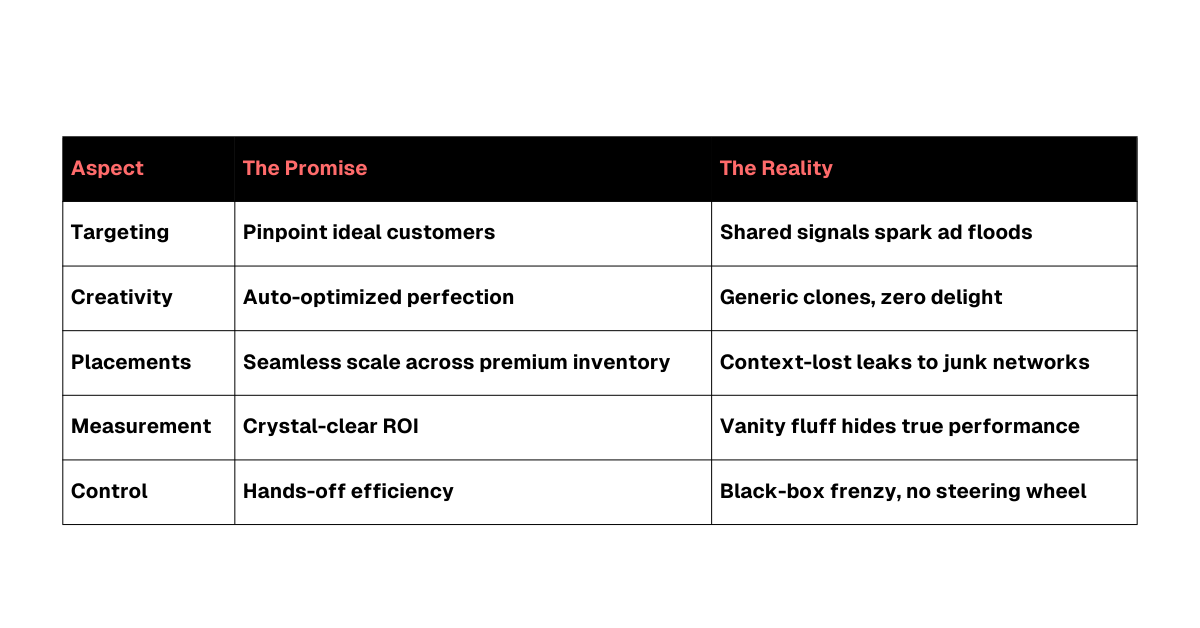
Everyone's using the same signals. My search triggered Meta pixels (from dealership sites I'd visited), Google tags, and DSP retargeting pools. That one query fed the collective data beast, and your customer's innocent site visit becomes ammo for competitors' segments. We've connected every device (phones, laptops, CTV) to these platforms, creating a feedback loop. Programmatic's promise relies on this data firehose, but it turns campaigns into a shark tank with all bidders chasing the same shrinking pool of high-intent eyeballs.
Friendly reality check: If you're not swimming alone, you're cannon fodder. This isn't unique, it's systemic. In 2025, cookie deprecation accelerated the shift to probabilistic modeling, making signals even noisier. Your "exclusive" audience? Shared with 50 rivals.
Here's where AI bites back. With universal tools like Canva AI for creatives, ChatGPT for copy, and universal targeting, campaigns homogenize.
Q: Why do all programmatic ads look and feel the same?
Same inputs yield same outputs. Platforms push "performance creative": Generic headlines ("Best Deals Now!"), stock truck images, urgency timers. No surprise, no delight. Humans craft narratives that entertain. AI optimizes for clicks. Result? Beige wallpaper across feeds. Studies show ad fatigue spikes 40% in high-competition verticals like auto, causing viewers scroll past because nothing stands out.
In our auto project, research showed 70% of regional ads mirrored competitors, Blue trucks on snowy roads, and "$0 down" banners. No edge. You've ditched differentiation for the herd's gameplan.
Q: Does this mean AI kills creativity?
Not kills. It dulls. It excels at A/B testing variants but lacks soul. Without human oversight, you're running vanilla plays while competitors (the smart ones) zig when you zag.
DSPs love whispering, "Expand to our full network for more reach!" It sounds smart, until it isn't.
Q: What's wrong with broader programmatic placements?
Context collapse. Ads leak into low-quality apps, pop-unders, or video pre-rolls on sketchy sites. No brand safety, no narrative fit. Returns? Mediocre. A 2025 IAB report found 25% of expanded programmatic inventory yields negative lift due to poor adjacency. Your premium truck message? Buried next to cat videos or worse.
We've traded control for volume. Platforms own the auction, leaving you to bid blindly.
A simple audit will expose ad placements surprise you?
Q: How do I know if programmatic is really working?
Dashboards glow with views, clicks, CTRs—but map to sales? Crickets. AI inflates vanity stats via arbitrage: Cheap inventory pumped with bots or low-attention views. True ROI? Last-click attribution ignores the full funnel. Economic uncertainty amplifies this—customers skeptical, budgets tight, yet "success" metrics say keep spending.
Q: What's the real cost of AI-driven programmatic?
Beyond dollars: Opportunity. Homogenized ads erode brand equity; poor placements damage reputation. Quantify it: Blend multi-touch attribution with real-world tests (like our truck shop-along). Reality vs. promise? 60% of marketers in a 2025 Forrester survey regretted over-reliance on AI opacity.
Q: Can I fix programmatic without ditching it?
Absolutely. Human oversight + AI = superpower. Here's your step-by-step:
In our auto project, this flipped the script: Custom video vignettes dropped CPA 35%, cut flood exposure 60%. You can too.
Q: What's the future of programmatic with AI?
Cleaner signals (privacy-first data), a revival of contextual targeting, and creative marketplaces. But winners will be those who treat AI as a co-pilot, not an autopilot. By 2027, expect regulations forcing more transparency—get ahead now.
Programmatic's not evil. It’s not that it doesn’t have its place. it's just oversold. The promise dazzles until the flood hits, ads blur, and metrics mislead. Keep humans steering: Differentiate, control context, chase reality. Next campaign, shop your own audience, feel the frenzy, then zig.
Questions answered, coffee cold? Drop yours below: Ever battled an ad flood? What's your fix for AI sameness? Spill—let's learn together. If this sparked ideas for your stack, follow for more no-BS ad tech breakdowns. Class dismissed.
The Growth Sequence Dispatch delivers one honest take, one practical tool, and one question worth asking, straight to your inbox.
.png)